
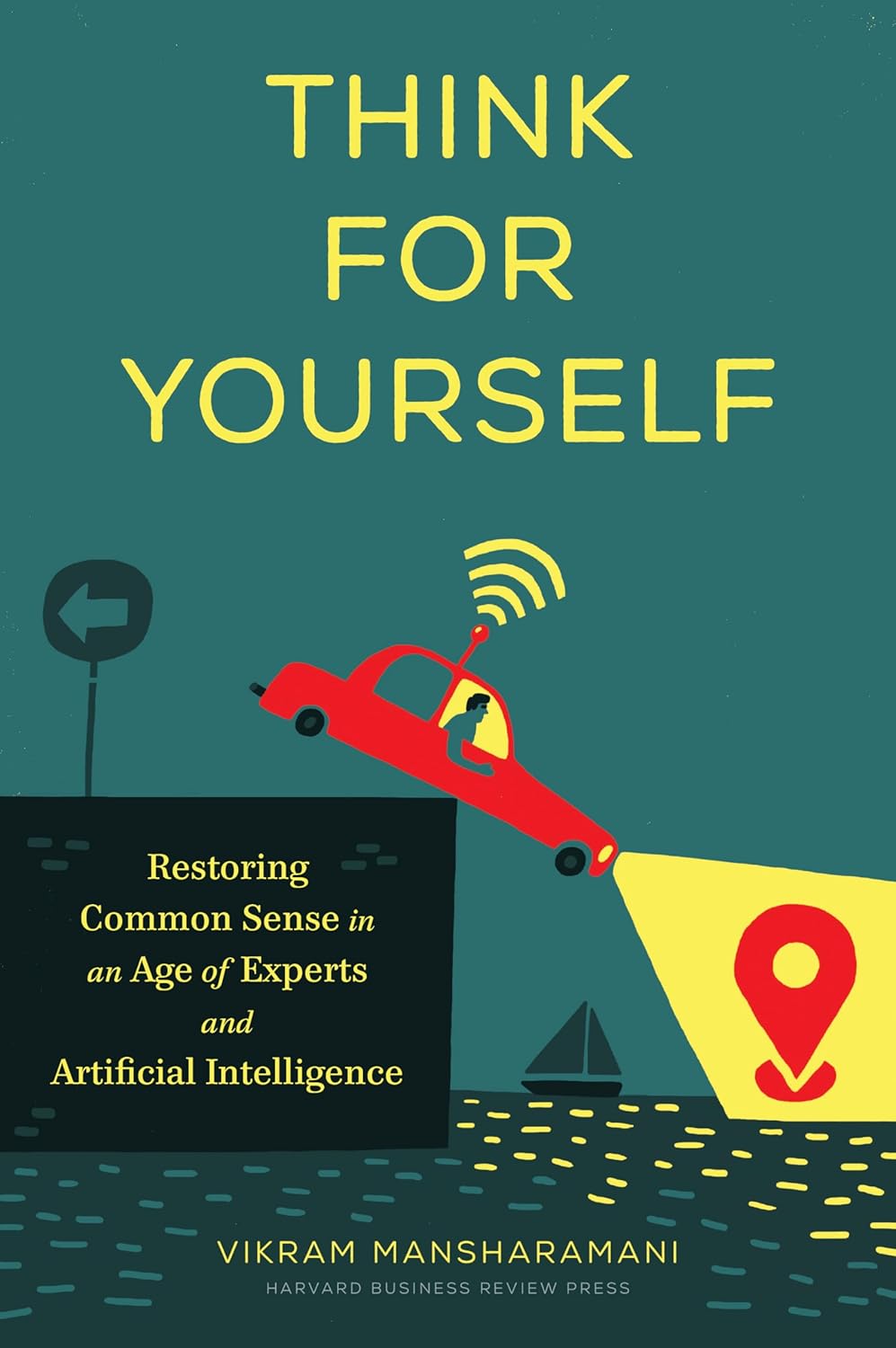
I am thrilled to announce that Think For Yourself: Restoring Common Sense in an Age of Experts and Artificial Intelligence by Vikram Mansharamani is the June 2026 pick for Courtney’s Corner Book Club.
Dr. Vikram Mansharamani is an academic, advisor, and author, as well as sought-after speaker who discusses navigating uncertainty. He has a PhD and two master’s degrees from MIT and a bachelor’s degree from Yale University. His ideas and writings have been featured in numerous leading publications, earning recognition as a LinkedIn Top Voice and inclusion in Worth magazine’s list of 100 Most Powerful People in Global Finance. In addition, he also advises boards and executive leadership teams on the business impact of global trends, helping organizations navigate risks.
I chose Think For Yourself: Restoring Common Sense in an Age of Experts and Artificial Intelligence for Courtney’s Corner for its emphasis on critical thinking and common sense as both indispensable counterbalances to the increasingly automated and specialized world we are living in. As Dr. Mansharamani mentions in the book, “Expert and technological input is essential, even if not sufficient. But we must always keep experts on tap, not on top.” While Think for Yourself was published in 2020, the primary message remains incredibly relevant in 2026. As artificial intelligence and specialized forms of expertise continue to shape both our individual decisions, as well as the decisions made in society, the book certainly raises an important, yet fundamental question of where the role of independent judgement remains.
Throughout the book, I found myself engaging in a process of metacognition, which I would critically think about my own thinking. Reading this book made me become increasingly attentive upon how I evaluate evidence, where I focus my attention, and synthesize varying perspectives, especially when researching areas where I may be more unfamiliar. For example, am I integrating all contextual variables and developing a grounded understanding of the issue, or am I merely aggregating perspectives without considering the deeper structures that actually shape them to begin with.
Dr. Mansharamani particularly gives a sport example where he discusses Phil Jackson, one of the most respected coaches in basketball history, as a master of focus management, which allowed him to excel at guiding his players’ attention in ways other coaches could not. Dr. Mansharamani explains how Jackson would take advantage of the opportunity to expose his players to new thinking and fresh perspectives. For example, after an unfortunate loss, Jackson took the team on a ferry ride to Staten Island as opposed to more interviews with the media. The point he makes in the book is how a deep expertise, when coupled with ambition and confidence, can narrow one’s perspective and obscure the broader context.
This book reinforced my appreciation for generalists in their capacity to connect ideas across disciplines while still considering the essential role of specialists in providing their unique domain rigor where it is needed. I also appreciated the reflective structure at the end of each chapter where Dr. Mansharamani invites the reader to critically engage with the material and consider its unique application to their own lived experience. This is where I felt like I was fostering a deeper, yet more personal form of intellectual integration. For example, at the end of the chapter, “Mindfully Manage Focus”, Dr. Mansharamani allows the reader to reflect upon the optimal degree of focus needed to address a challenge, while zooming out to consider the appropriate level of analysis required to effectively understand complex problems.
I highly recommend this book for any leader, student, or simply any individual interested in cultivating greater intellectual autonomy or desires to reclaim independent judgement in an era that is dominated by expertise and artificial intelligence.